
From the Outside Looking In: Why Are So Few People Voting in Birmingham’s Mayoral Elections?
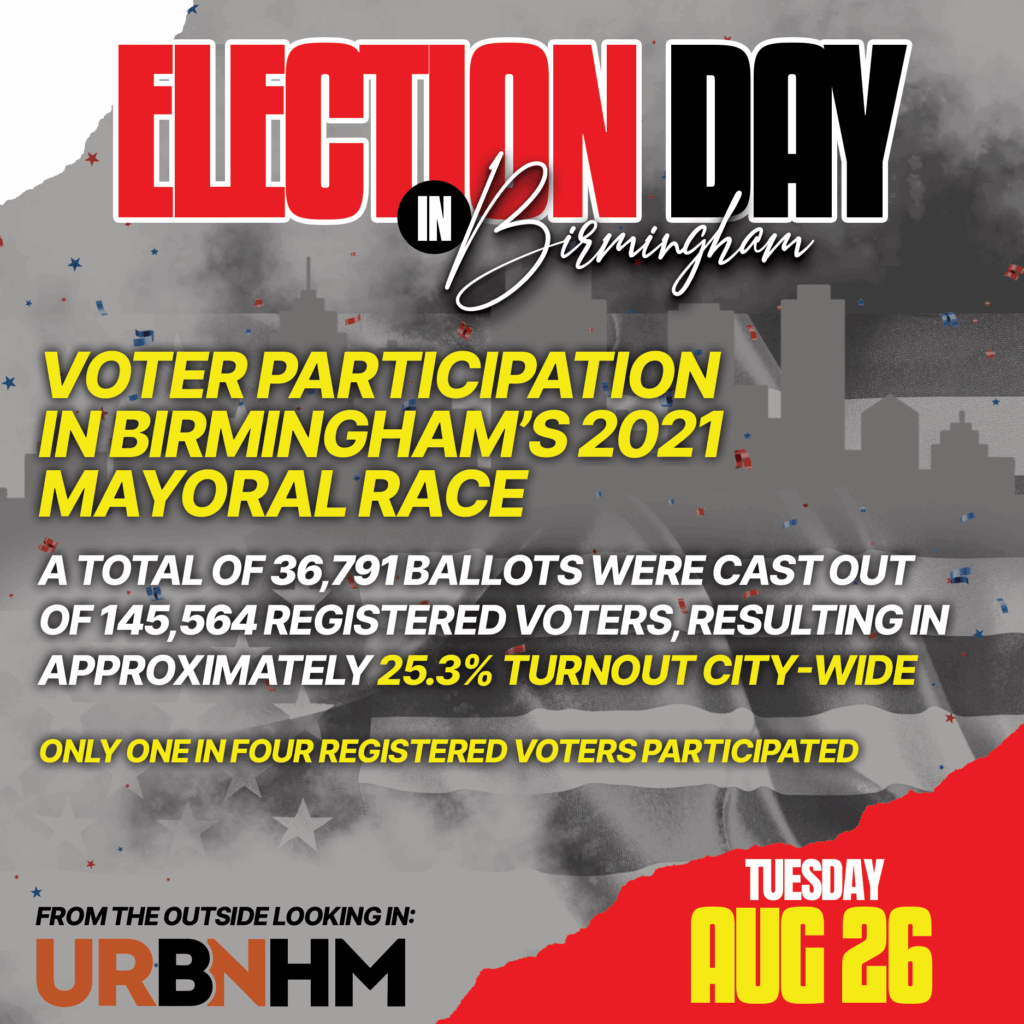
When Birmingham held its last mayoral election in 2021, only 25.3% of registered voters showed up. That means nearly 3 out of 4 eligible voters stayed home—despite the fact that city leadership controls everything from neighborhood investment and crime prevention to roads and water (ummm not so fast on this one / lawsuit pending).
So, why was voter participation so low in a city with so much on the line?
The Numbers Don’t Lie
Out of 145,564 registered voters, only 36,791 cast ballots. Mayor Randall Woodfin won re-election decisively with 64.3% of the vote, avoiding a runoff and carrying every single precinct. Challenger Lashunda Scales secured second place with 20.8%, while former Mayor William Bell came in third with 9.1%.
But when you look beyond the vote totals, a more urgent story emerges: apathy, disengagement, or disillusionment with local politics is quietly eating away at our democracy.
Why So Few Voted
There’s no single answer, but several factors likely contributed:
Lack of awareness – Many residents don’t even know when local elections are held, especially when they occur in off years and during the summer.
- Negative campaigning and distrust – Constant negativity on social media and in public discourse often pushes people away instead of pulling them in.
- Feeling powerless – Some voters don’t see city hall as a place where their voice matters, particularly when they’ve seen promises go unfulfilled.
- Low media coverage – Local elections don’t get the spotlight that state and national races do. Without widespread media engagement, many voters tune out. (See: Birmingham Mayoral Candidate Juandalynn Givan Files FCC Complaint Against WBRC Fox 6)
Is This a National Trend?
Unfortunately, yes.
Cities across the country—especially those run by Democrats—are seeing low turnout in local races, even as these cities face rising challenges like crime, housing costs, and infrastructure decay. From Baltimore to St. Louis to Birmingham, urban voter participation is shrinking, even though these cities often have the most at stake.
Why? Because the communities most affected by city leadership are often the ones least empowered to shape it. The result? A feedback loop of frustration, where low turnout leads to stagnation, and stagnation leads to even lower turnout.
What Can Be Done?
Here’s how we can flip the script:
- More civic education – Voter registration is just the beginning. We need to teach residents how local government works and why their vote truly matters.
- Positive, issues-focused campaigning – When elections become smear campaigns, voters disengage. Let’s bring back a culture of honest debate, not mudslinging.
- Neighborhood mobilization – While online campaigning may offer an easier option, real engagement happens block by block. If candidates and civic leaders want higher turnout, they must meet people where they are—in churches, barbershops, front porches and festivals
Final Word: Don’t forget Voting Is Power
From the outside looking in, low voter turnout might seem like apathy. But from the inside looking out, it’s more often the result of broken trust, weak outreach, and lack of visibility.
We don’t endorse candidates, but we do believe in participation, integrity, and accountability. If we want Birmingham to reach its potential, we need more voices at the table—not fewer. That starts with showing up.
This could be the only time (until the next election) that you actually get the ear of those running for public office so make 2025 the year Birmingham turns the page—by voting, by speaking up, and by demanding the best.
Urbanham.com