
Birmingham Tightens Drone Enforcement Ahead of Magic City Classic: What Every Drone Owner Needs to Know
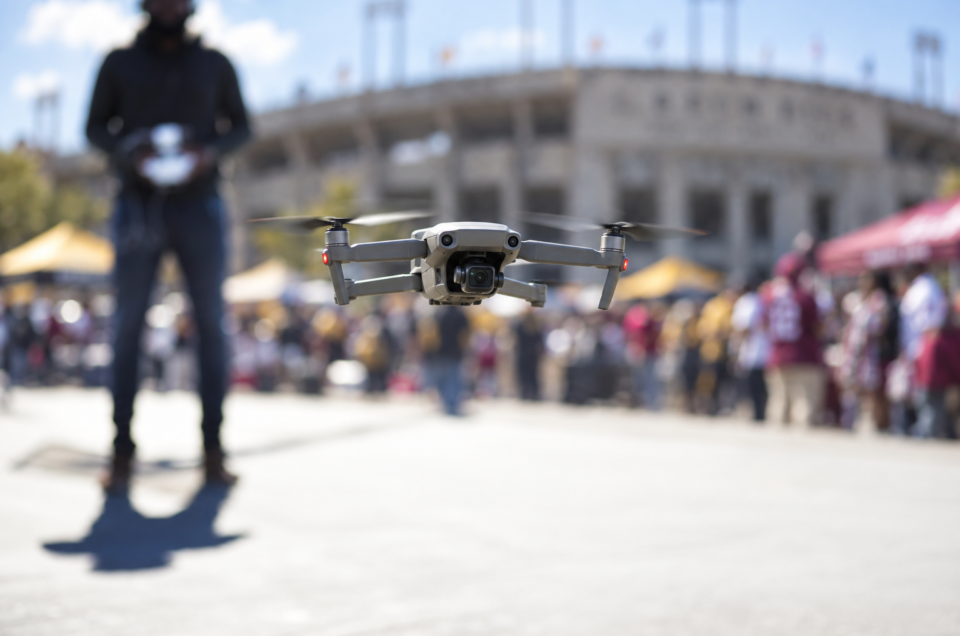
With more than 70,000 seats at Legion Field and thousands expected for Classic weekend, Birmingham’s new drone enforcement measures raise important questions for recreational flyers, photographers, videographers, and social media content creators.
Urbanham.com | October 22, 2026
As Birmingham prepares for the 85th Magic City Classic on Saturday, October 31, 2026, city leaders are taking additional steps to address unauthorized drone flights around major public events.
The Birmingham City Council took up new drone-related enforcement legislation during its October 20 meeting, just 11 days before Alabama A&M University and Alabama State University meet at historic Legion Field.
The proposed municipal ordinance would add first-offense drone violations near ticketed entertainment events to Birmingham’s existing municipal fine schedule. The measure builds on a new Alabama law that took effect October 1, 2026.
For recreational drone enthusiasts, photographers, videographers, and anyone hoping to capture aerial footage of the Magic City Classic, the message is clear: The ability to fly a drone does not automatically mean you have legal permission to fly it at a particular location or event.
Even a small recreational drone, including lightweight DJI models, can be subject to significant restrictions during major sporting events.
What Birmingham’s October 20 City Council Agenda Actually Says
According to the official Birmingham City Council agenda for October 20, 2026, the drone measure appeared on page 5 as Item 14.
The proposed ordinance would amend Title 8, Chapter 3, Section 10 of Birmingham’s Municipal Code, which governs the summary disposition of minor offenses through a fine schedule.
Specifically, it would add a first offense for unlawful use of an unmanned aircraft system near a ticketed entertainment event, referencing Alabama Code §13A-7-110.
The item was submitted by the City Attorney and recommended by the City Council’s Public Safety Committee.
The official agenda designated the measure for its first reading. Subsequent local reporting described the council as having approved the measure, although Urbanham has not independently verified the signed final ordinance or its effective date.
The distinction is important because the city measure focuses on a local method of enforcing a violation already established under Alabama law.
The ordinance does not establish a separate citywide drone pilot licensing system or replace federal aviation regulations.
The city measure adds a local enforcement mechanism. The underlying statewide prohibition was already in effect.
Alabama’s New Drone Law: The 400-Foot Rule
Alabama House Bill 429 became law in 2026, with an effective date of October 1.
The legislation prohibits operating a drone directly above or within 400 feet of qualifying ticketed entertainment events unless a statutory exception applies.
Under the law, qualifying events include gated or access-restricted music, sporting, and performing arts events that require permission or a ticket to attend.
Penalties include:
- First violation: A fine of up to $500.
- Second or subsequent violation: A Class A misdemeanor, potentially carrying jail time and additional penalties under Alabama criminal law.
The legislation identifies several exceptions. These include operators who obtain consent from someone with legal authority over the event; operators flying lawfully under applicable federal regulations; venue or utility employees conducting official duties; qualifying public-safety personnel; and limited private-property operations that satisfy specific conditions.
Middle school and high school sporting events are also excluded from the statute’s restrictions.
However, exceptions must be evaluated carefully. A person may qualify for an exception under state law while still being prohibited from flying under federal aviation restrictions.
That difference becomes particularly important during the Magic City Classic.
Why Magic City Classic Drone Restrictions Extend Far Beyond Legion Field
The Magic City Classic is among Birmingham’s most significant annual cultural events, attracting alumni, families, tailgaters, vendors, and visitors from across the United States.
Legion Field has a seating capacity exceeding 70,000, and the festivities extend beyond the stadium itself.
According to the official Magic City Classic schedule, events on Saturday, October 31, include:
| Event | Time | Location |
| Magic City Classic Parade | 8 a.m. | Downtown Birmingham |
| Pregame Tailgate Party | 10 a.m.–2 p.m. | Legion Field, West Side Parking Lot |
| Alabama A&M vs. Alabama State | 2:30 p.m. | Legion Field |
While Alabama’s new law restricts drones within 400 feet of qualifying events, federal rules create a much larger restricted area around certain stadium sporting events.
The FAA prohibits unauthorized drone operations within three nautical miles of qualifying stadiums during NCAA Division I football games.
The restriction extends from the ground up to and including 3,000 feet above ground level.
It begins one hour before the scheduled game and remains in effect until one hour after the game concludes.
For the 2026 Magic City Classic’s 2:30 p.m. kickoff, that means the federal stadium restriction is scheduled to begin at 1:30 p.m. and remain active until one hour after the football game ends.
Three nautical miles equals approximately 3.45 regular miles.
That is a substantial area surrounding Legion Field.
A drone launched from a neighborhood or private property several miles from the stadium could still be inside the restricted airspace.
This restriction applies to small recreational drones and professionally operated aircraft alike, unless a specific federal exception or authorization permits the operation.
Importantly, a basic FAA airspace authorization or a Part 107 certificate does not, by itself, provide permission to disregard a stadium flight restriction.
What about flying over the parade or tailgating?
The Magic City Classic parade is a free public event downtown, while activities at Legion Field include ticketed football and designated tailgating areas.
A free public parade does not automatically qualify as a ticketed entertainment event under Alabama’s new law.
However, that does not mean recreational drones can freely operate above parade spectators.
FAA rules governing flights over people, crowded gatherings, controlled airspace, and other temporary restrictions still apply.
Operators should check the specific location and time rather than assume a free event is automatically open to drone flights.
Can You Legally Fly a Drone in Birmingham Without a License?
Yes, in certain circumstances.
The FAA distinguishes between purely recreational flights and flights conducted for non-recreational purposes.
For example, flying a drone in an appropriate open location simply for personal enjoyment may qualify as recreational activity.
However, using that same drone to produce promotional content for a business, document an event for a media organization, photograph real estate listings, or perform other business-related assignments generally falls under FAA Part 107 regulations.
Whether the operator receives payment is not the only determining factor.
Recreational Drone Flyers
Recreational pilots generally do not need a Part 107 Remote Pilot Certificate.
They must, however:
- Complete the FAA’s free Recreational UAS Safety Test, known as TRUST, and carry proof of completion.
- Register drones weighing 250 grams or more, including attached equipment and payload, when registration is required.
- Comply with Remote ID requirements when applicable.
- Follow applicable FAA-recognized community-based organization safety guidelines.
- Maintain visual line of sight.
- Yield to crewed aircraft.
- Follow altitude limits, generally 400 feet above ground level in uncontrolled airspace.
- Obtain FAA authorization before operating in controlled airspace when required.
- Avoid unauthorized flights over crowds, restricted stadiums, and other prohibited areas.
Lightweight drones may be exempt from recreational registration requirements under certain conditions, but they are not automatically exempt from FAA airspace restrictions.
Professional and Non-Recreational Drone Operators
Drone operators using aircraft for most business and professional purposes should obtain an FAA Part 107 Remote Pilot Certificate.
This involves passing the FAA’s aeronautical knowledge examination and meeting the agency’s certification requirements.
Part 107 operators generally must register their drones, comply with Remote ID, and follow applicable rules for flight altitude, airspace access, operations over people, and visual line of sight.
Special operations may require additional FAA waivers or authorizations.
Professional credentials are important, but certification alone does not give pilots blanket permission to fly above major events or restricted airspace.
Comparing the Rules: Birmingham, Jefferson County, Alabama, and the FAA
Drone owners operating throughout the Birmingham metropolitan area must understand how different levels of government affect their flights.
| Jurisdiction | Rules and requirements | Impact on drone owners |
| City of Birmingham | Proposed municipal fine-schedule amendment for a first violation of Alabama’s ticketed-event drone law. | Supports city-level enforcement of unauthorized flights near qualifying events. Final ordinance status and implementation details should be checked with the city. |
| Jefferson County | No separate, generally applicable countywide drone ordinance was confirmed in the public sources reviewed. | State and FAA restrictions still apply throughout Jefferson County. County property rules and individual municipalities may impose additional applicable restrictions. |
| State of Alabama | Alabama Code §13A-7-110 prohibits specified unauthorized drone operations above or within 400 feet of qualifying ticketed entertainment events. | A first violation can produce a fine of up to $500. A second or subsequent violation is a Class A misdemeanor. Statutory exceptions apply. |
| Federal Government / FAA | Rules governing recreational flying, Part 107 certification, registration, Remote ID, airspace, safety, and special event restrictions. | Qualifying major stadium events trigger a restriction generally covering a three-nautical-mile radius and altitudes up to 3,000 feet above ground level during specified hours. |
Jefferson County includes Birmingham and numerous other municipalities, including Bessemer, Hoover, Homewood, and Vestavia Hills.
Birmingham’s municipal ordinance does not automatically apply as a city ordinance within every other municipality.
However, Alabama and federal aviation laws continue to apply regardless of municipal boundaries.
Operators also need to respect the rules governing the property from which they launch or land. Permission to access a park, campus, stadium, or private property is a separate issue from permission to occupy the airspace above it.
What Should a Drone Owner Have Before Flying in Birmingham?
Before operating a drone around Birmingham, owners should be prepared to produce or verify the following, as applicable:
For recreational users:
- TRUST completion certificate.
- FAA aircraft registration and proof, if required.
- Proper Remote ID capability, when required.
- A current FAA airspace check for the location.
- Any necessary airspace authorization.
- Permission to use the intended launch and landing location.
- Familiarity with applicable state event restrictions and local rules.
For professional operators:
All applicable aircraft requirements, plus an FAA Remote Pilot Certificate, required identification, relevant airspace approvals and waivers, and event or property permissions.
Business operators should also consider appropriate liability insurance and written operating agreements, particularly when working around clients, venues, or public gatherings.
Why More Drone Owners Should Consider FAA Part 107 Certification
Drone technology has made aerial photography and videography accessible to consumers who once could only obtain those images through expensive professional production services.
Today, drones are used for commercial photography, construction documentation, tourism marketing, property inspections, real estate, event coverage, and more.
For individuals interested in turning drone flying into a legitimate business opportunity, FAA certification is an important professional step.
The Part 107 process teaches essential knowledge involving airspace, aviation weather, emergency procedures, flight operations, and regulatory responsibilities.
It also establishes a foundation for pursuing professional assignments responsibly.
For photographers, videographers, entrepreneurs, and aspiring media professionals in Birmingham, becoming a certificated remote pilot can open opportunities while helping reduce legal and safety risks.
But obtaining a certificate should be seen as the beginning of professional development—not permission to operate without limitations.
The Bottom Line for Magic City Classic Weekend
The Magic City Classic is an opportunity to celebrate HBCU traditions, culture, music, community, and one of Birmingham’s largest sporting events.
It is also a time when crowded streets, stadium activity, and heightened public-safety operations make unauthorized drone flights particularly risky.
A person flying a recreational drone to capture a spectacular aerial photograph could unknowingly enter federally restricted airspace—even while standing on private property outside Legion Field.
The safest recommendation for casual drone owners attending the Classic is simple: Leave the drone at home and enjoy the event from the ground.
For professional drone operators seeking event footage, plan well in advance, verify federal restrictions, obtain all necessary approvals, and never assume that a client, promoter, venue, or local official can override FAA requirements.
Birmingham’s new enforcement initiative is another reminder that drone ownership comes with responsibilities.
Whether flying for entertainment or pursuing a career in aerial photography, pilots should understand the rules, respect public safety, and approach every flight with preparation and caution.
Before you launch, know the law, check the airspace, and make sure you have permission to fly.
Official Resources for Drone Owners
Readers can consult the following primary sources for additional information:
- Birmingham City Council — October 20, 2026 Agenda, Item 14
- Alabama HB429 — Enrolled Legislation
- FAA — Recreational Drone Rules and TRUST
- FAA — Become a Drone Pilot (Part 107)
- FAA — Register Your Drone
- FAA — B4UFLY Airspace Tools
- FAA — Stadium Drone Restrictions
- Magic City Classic — Official Game Day Schedule
This article is intended to provide general public information. Drone regulations and flight restrictions may change, and operators remain responsible for verifying requirements before each flight. This article is not legal advice.